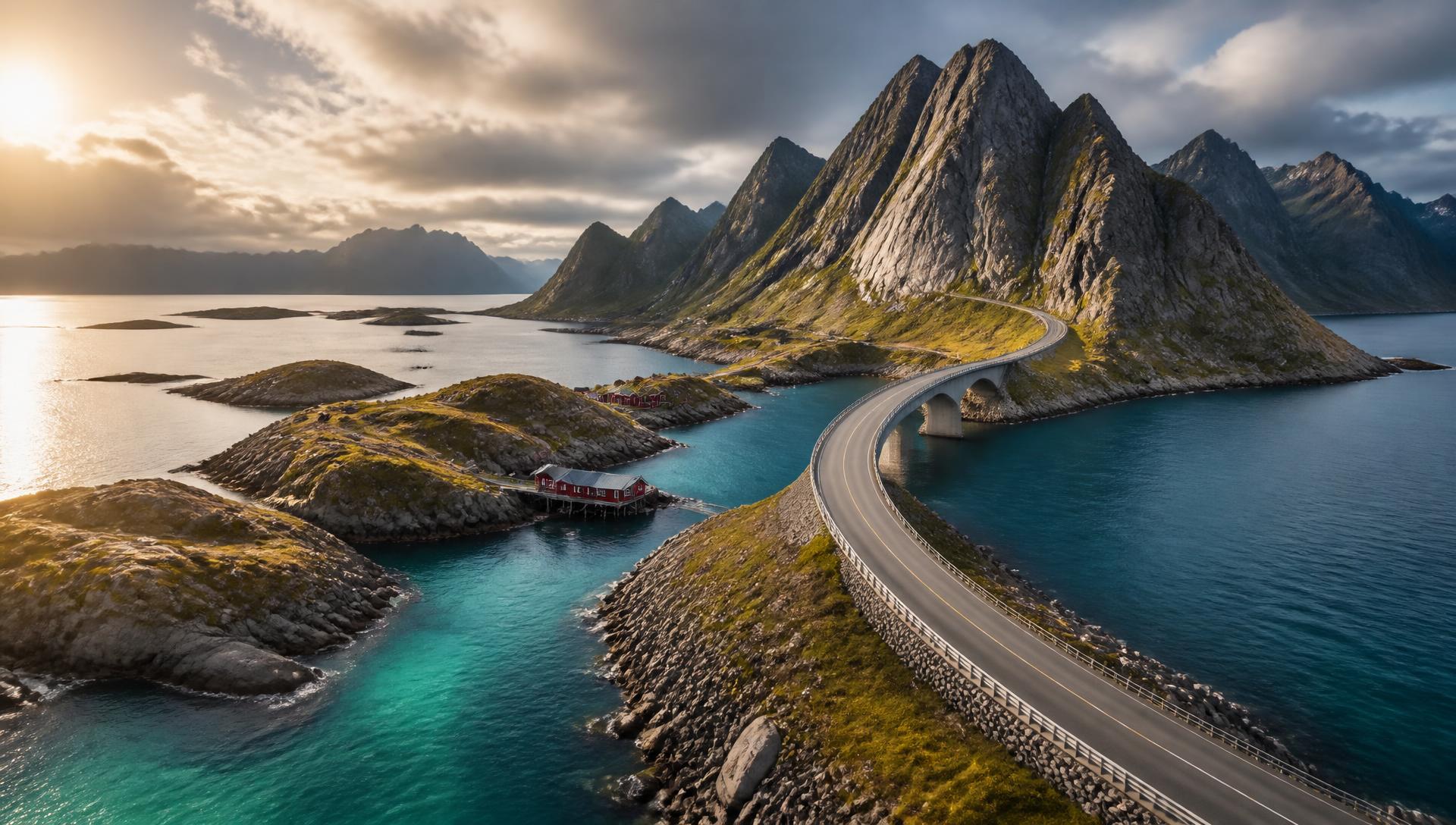
Oslo to Lofoten, Norway
All road trips

Norway · Trøndelag, Helgeland, Nordland & Lofoten

Oslo to Lofoten

Norway's spectacular coastal road trip via Trondheim, Kystriksveien and the Helgeland Coast

14 days~2,400 kmCalculating… drivingOslo → Svolvær, Lofoten

The flagship version: unhurried Kystriksveien days, all six coastal ferries and a full week in Lofoten.

About this route

Most people drive north on the E6 because it is quicker. This route exists because it is not. From Steinkjer, Fv17 — Kystriksveien — spends 650 km refusing to take the direct line, hopping between islands and fjord mouths on six car ferries, past Torghatten's pierced mountain, the Seven Sisters, the Svartisen glacier and finally Saltstraumen's tidal current. At Bodø the road runs out and a ferry takes over for the Vestfjorden crossing into Lofoten, where the last week belongs to Reine, Nusfjord, white-sand beaches, Henningsvær and Svolvær. Fourteen days is the version we recommend: enough for the ferries to be a pleasure rather than a stress, and enough to spend whole afternoons not driving.

Coastal sceneryFerries and islandsPhotographyBeachesCampervan travelArctic landscapes

Why drive this route?

The E6 will get you from Oslo to Narvik in two long days. Kystriksveien takes a week and never once feels like a compromise. This template is built on the idea that the journey is the trip: the ferries are not obstacles between destinations, they are the reason to come.

  • Slower coastal driving instead of motorway kilometres
  • Six car ferries on the Helgeland scenic section, plus the Vestfjorden crossing
  • Islands, fjords and mountains that arrive one after another
  • The Arctic Circle crossed at sea rather than at a roadside monument
  • Beaches, fishing villages and Lofoten's light at the end of it

Day by day

A deliberately long first day: the E6 climbs out of Oslo through Gudbrandsdalen, crosses the Dovrefjell plateau and drops into Trøndelag. It is the price of admission for the coastal road that follows — break it properly rather than driving it in one push.

Roads: E6

Where to stay

Trondheim

Stay central — Bakklandet and the Nidelva riverside are walkable from most city hotels.

Roadly suggestions

Trondheim city centre hotels

hotel · comfort

Walking distance to Nidaros Cathedral and Bakklandet.

Trondheim budget rooms & hostels

hostel · budget

Trondheim area campsites

campsite · budget

Full service pitches; check current opening outside summer.

Campervan & Motorhome Stops

Find campsites, motorhome areas, overnight stops and useful services near Trondheim.

Park4Night can help you discover campsites, motorhome areas, parking and stopping places, water, waste services, laundry and other traveller services.

Opens an external service

Park4Night is an external service. Always check current local signs, site rules and overnight restrictions before staying.

  • Split this drive if you prefer: an overnight around Lillehammer or Dombås turns one long day into two relaxed ones (built into the 18-day version).
  • Fuel and charging are plentiful the whole way — Dombås and Oppdal are the natural break points.
  • Musk oxen live on Dovrefjell, but they are wild animals seen from a distance, not a roadside attraction.

Ferry timetables

Ferry schedules can change by date and season. Roadly links directly to the official operators so you can check the latest departures before travelling.

  1. Holm → Vennesund18-115Day 3Usually no booking
    HolmVennesund ~20 min afloatArrive ~20 min earlyFv17 KystriksveienOperator: Torghatten

    The first Kystriksveien crossing and the entrance to Nordland county.

    Fares vary with vehicle length and height — check the current fare before travelling.

    Boarding is normally first-come, first-served — Roadly does not hold or confirm space.

    Check timetableOfficial timetable · TorghattenCheck ferry service updatesCheck current status
  2. Horn → Anddalsvåg18-153Day 4Usually no booking
    Horn (Brønnøy)Anddalsvåg (Vevelstad) ~20 min afloatArrive ~20 min earlyFv17 KystriksveienOperator: Torghatten

    Departs just north of Brønnøysund; some sailings connect onwards to Vega.

    Fares vary with vehicle length and height — check the current fare before travelling.

    Check timetableOfficial timetable · TorghattenCheck ferry service updatesCheck current status
  3. Forvik → Tjøtta18-162Day 4Usually no booking
    Forvik (Vevelstad)Tjøtta (Alstahaug) ~45 min afloatArrive ~25 min earlyFv17 KystriksveienOperator: Reis Nordland

    A genuinely scenic crossing with island and mountain views — stay on deck if the weather allows.

    Fares vary with vehicle length and height — check the current fare before travelling.

    Check timetableOfficial timetable · Reis NordlandCheck ferry service updatesCheck current status

    Look for route 18-162 — Tjøtta–Forvik (the Fv17 car ferry, not 18-167).

  4. Levang → Nesna18-335Day 5Usually no booking
    Levang (Leirfjord)Nesna ~25 min afloatArrive ~20 min earlyFv17 KystriksveienOperator: Torghatten

    One of the busiest Kystriksveien crossings in high summer; frequency is usually good.

    Fares vary with vehicle length and height — check the current fare before travelling.

    Check timetableOfficial timetable · TorghattenCheck ferry service updatesCheck current status
  5. Kilboghamn → Jektvik18-414Day 6Usually no booking
    Kilboghamn (Rødøy)Jektvik (Rødøy) ~60 min afloatArrive ~30 min earlyFv17 KystriksveienOperator: Torghatten

    Crosses the Arctic Circle at roughly 66°33′ north

    The longest Kystriksveien crossing, and the one that carries you over the Arctic Circle. Sailings are less frequent than the southern ferries — plan the day around the timetable, not the other way round.

    Fares vary with vehicle length and height — check the current fare before travelling.

    Check timetableOfficial timetable · TorghattenCheck ferry service updatesCheck current status
  6. Ågskardet → Forøy18-421Day 7Usually no booking
    Ågskardet (Meløy)Forøy (Meløy) ~10 min afloatArrive ~15 min earlyFv17 KystriksveienOperator: Torghatten

    The shortest of the six coastal crossings, with the Svartisen massif ahead of you.

    Fares vary with vehicle length and height — check the current fare before travelling.

    Check timetableOfficial timetable · TorghattenCheck ferry service updatesCheck current status
  7. Bodø → Moskenes18-782Day 8Booking recommended
    BodøMoskenes (Lofoten) ~195 min afloatArrive ~60 min earlyVestfjorden car ferryOperator: Torghatten

    Roughly three to four hours across open water, weather dependent. Crossings can be delayed or cancelled in heavy seas.

    Campervans and motorhomes are charged by length and height; oversized vehicles may need to book ahead.

    Vehicle space on the Vestfjorden crossing can sell out in summer. Check the operator for current booking rules — Roadly cannot confirm availability.

    Check timetable & bookingOfficial timetable · TorghattenCheck ferry service updatesCheck current status

Check ferry times before setting off each morning, particularly on Route 17 where missing a sailing can significantly affect your day's journey.

Weather on this route

Late spring to early autumn is the classic version of this trip: long daylight, all ferries running their summer frequency and every service open. Dates beyond the 16-day forecast window show a seasonal outlook.

Weather along the way

Checking the forecast for your dates…

Approximate costs

Indicative totals for 14 days, 2 adults. Fuel is based on the live route distance.

Budget

€1,350–€3,250

  • Accommodation€500–€1,150
  • Food & drink€420–€700
  • Attractions & activities€0–€350
  • Fuel€300–€440
  • Ferries€120–€320
  • Parking€0–€280

Comfort

€3,550–€6,700

  • Accommodation€1,800–€3,000
  • Food & drink€1,000–€1,700
  • Attractions & activities€350–€1,000
  • Fuel€300–€440
  • Ferries€120–€320
  • Parking€0–€280

Premium

€7,000–€12,900

  • Accommodation€3,650–€6,250
  • Food & drink€1,950–€3,350
  • Attractions & activities€1,000–€2,250
  • Fuel€300–€440
  • Ferries€120–€320
  • Parking€0–€280
  • Ferry fares are set per vehicle length and height and change — Roadly shows an estimated range, never a quoted fare. Check the current price with the operator.
  • The Bodø–Moskenes crossing is the single largest ferry cost on the route.
  • Norwegian toll roads bill automatically via AutoPASS; rental vehicles are invoiced afterwards.
  • Popular Lofoten car parks (Haukland, Utakleiv, Reine, Nusfjord) charge daily fees.
  • Estimates only — Roadly never quotes live prices.

Optional detours

Vega islands

A UNESCO World Heritage archipelago off Brønnøysund, known for eider-down harvesting and low, luminous island scenery.

Adds at least a full day

Requires a separate ferry from the Brønnøysund area — plan the crossing before committing.

Lovund

A steep island off the Helgeland coast with a large puffin colony that returns each spring.

Adds 1–2 days

Passenger/car connections run from the Helgeland coast; check current sailings.

Træna

One of Norway's oldest fishing communities, far out to sea beyond Lovund.

Adds 2 days

Reached by boat from the Helgeland coast; sailings are limited and weather-dependent.

Mosjøen inland loop

An inland alternative on the E6 through Mosjøen if a Kystriksveien ferry is cancelled and you need to keep moving north.

Same-day alternative

Extend the trip

Continue to Narvik

Leave Lofoten by the E10 across Vesterålen and the Tjeldsund bridge to Narvik, with the Ofoten railway and mountain scenery at the end.

Adds roughly 1–2 days

Vesterålen

The quieter archipelago immediately north of Lofoten: whale watching from Andenes, big skies and far fewer visitors.

Adds roughly 2–3 days

Senja

Norway's second-largest island, with the Scenic Route past Tungeneset, Bergsbotn and Ersfjord.

Adds roughly 2–4 days

Tromsø

The Arctic city: cable car, cathedral and the best base in northern Norway for winter aurora trips.

Adds roughly 2–3 days

Nordkapp

The long push to the North Cape plateau at 71° north. A serious extension, best treated as its own road trip.

Adds roughly 5–7 days

Who this route suits

Families

good

Ferries, beaches and Viking longhouses keep children interested, but this is a long trip with some big driving days.

  • · Every ferry is a break from the car seat — most children love this route for exactly that reason.
  • · Lofotr Viking Museum, the Lofoten beaches and Saltstraumen are reliable family stops.
  • · Cliff edges, unfenced viewpoints and cold water need supervision; the Torghatten walk is too rough for small children.
  • · The Oslo–Trondheim day is long — split it if you are travelling with young children.

Campervans

excellent

One of Europe's great camper routes: campsites in nearly every overnight area and a road built for slow travel.

  • · Campsites and camper stops are frequent along Fv17 and throughout Lofoten in summer.
  • · Ferry fares depend on vehicle length and height — check the current fare rather than assuming a car price.
  • · Some Lofoten car parks ban overnight stays; local rules are posted and enforced.
  • · Motorhome service points are reported along Fv17, including around Storvika, Hellåga, Sandnessjøen, Nesna and Brønnøysund — verify current status on site.

Motorhomes

good

Comfortable on the main roads, with a handful of narrow detours to think about.

  • · Fv17, E6 and E10 are all fine for a large motorhome.
  • · Nusfjord, Henningsvær, Utakleiv and Unstad access roads are narrow, steep or single-lane — check dimensions first.
  • · Ferry queues in July can be long; oversized vehicles board last on busy sailings.

Electric vehicles

Norway is the easiest country in Europe to drive electric, and this route is well covered on the E6, E10 and in the larger Fv17 towns. Rural chargers can be single-unit, so plan charges around verified locations and keep a buffer before ferry legs — Roadly's EV planning uses live charging data only.

  • · Tolls are charged automatically through AutoPASS; there are no cash barriers.
  • · Ferry fares vary with vehicle size and are not quoted by Roadly.
  • · Fuel is expensive by European standards; refuel in towns rather than at the last minute.

Practical travel notes

Driving side
Right.
Currency
Norwegian krone (NOK). Cards are accepted almost everywhere, including small ferry quays and unstaffed fuel pumps.
Roads
E6 and E10 are main highways. Fv17 is a good but narrow two-lane road with frequent tunnels, blind crests and single-lane sections on side roads.
Ferries
Six county ferries on Kystriksveien plus the Bodø–Moskenes crossing. Boarding is generally first-come, first-served on the county routes; check current timetables daily and arrive early in summer.
Tolls & AutoPASS
Tolls are collected electronically through AutoPASS — there are no barriers. Ferry fares can also be linked to an AutoPASS ferry account; check current rules before travelling.
Fuel
Towns along Fv17 have fuel, but the gaps between them are long and some stations keep short hours. Refuel at Brønnøysund, Sandnessjøen, Nesna, Ørnes and Bodø rather than waiting.
EV charging
Norway has dense charging coverage, though rural Fv17 chargers can be single-unit and busy in summer. Plan around verified chargers only — Roadly will not invent one.
Campervans & motorhomes
Excellent for camper travel, with campsites in most overnight areas. Overnight parking rules vary locally; obey posted signs and never treat a public toilet as a waste-disposal point.
Speed limits
Typically 80 km/h on open roads, 50 km/h or less in towns, and lower again in tunnels and roadworks. Enforcement is strict and fines are high.
Daylight
In midsummer there is effectively no darkness north of the Arctic Circle. Plan sleep deliberately — it is easy to drive far too late.
Weather
Coastal weather changes fast. Strong wind and heavy rain can delay or cancel sailings; always check current ferry status rather than inferring it from a forecast.
Connectivity
Mobile coverage is good in towns and patchy in tunnels, on remote Fv17 sections and at sea. Download maps and ferry timetables before long stretches.

Roadly tips

  • · Plan each Fv17 day around the ferry timetable, not the other way round.
  • · Arrive at county ferry quays 20–30 minutes early in summer; missing a sailing can cost you hours.
  • · Book Lofoten accommodation months ahead for June to August.
  • · Carry food for the Nesna–Ørnes stretch; services are thin outside peak season.
  • · Give yourself a spare night in Bodø rather than betting the trip on one crossing.
Loading map…

Highlights

Best time to go

J
F
M
A
M
J
J
A
S
O
N
D
bestgoodpossiblechallenging
  • Late spring to early autumn is the classic version of this trip: long daylight, all ferries running their summer frequency and every service open.
  • Winter is a genuinely different journey — limited daylight, possible closures and difficult conditions, in exchange for northern-lights nights. It is not the same road trip in a colder coat.
  • North of the Arctic Circle the midnight sun runs through roughly late May to mid-July, and the polar night through roughly early December to early January. Roadly only shows these when your dates fall inside them.
  • Aurora cannot be forecast months ahead. Roadly will never promise you a sighting.